If you’re driving in Cavite, the province has suspended its Unified Vehicular Reduction System (UVRS), also known as the Cavite number coding scheme under Provincial Ordinance No. 283-2020, and the suspension remains in effect until further notice. That said, there is no need to be wary when driving around Cavite. Because the suspension is still in effect to this day, drivers can travel anywhere in Cavite regardless of plate number.
Just like in Metro Manila, the neighboring province of Cavite also attempted their version of the number coding scheme in 2018 to restrict vehicles and regulate traffic flow along major highways, especially during peak travel periods. However, the coding scheme was formally placed on indefinite hold under Provincial Ordinance No. 283-2020. To date, the ordinance remains suspended because the provincial government has not yet reactivated the policy. This means that as of now, there are no Cavite coding hours to follow, but it’s always best to learn about it early in case the provincial government reinstates it.
What Are Cavite Coding Hours?
The Cavite coding scheme, otherwise known as the UVRS, was a system implemented and later scrapped by the Provincial Government of Cavite. Originally established through Provincial Ordinance No. 164-2016 to regulate traffic flow along major highways where congestion is common, it was later amended by Provincial Ordinance No. 173-2017 and officially enforced on February 5, 2018.
The scheme identified major provincial and national roads identified as traffic choke points and restricted private vehicles such as cars, vans, and trucks. The restrictions, like in Metro Manila, followed a weekday rotation system based on the last digit of the plate number or conduction stickers.
Implementation
The coding system was introduced to manage traffic congestion across Cavite’s rapidly growing road network.The policy works by reducing the number of vehicles on major roads during peak hours, which helps:
- Improve traffic flow
- Reduce travel time
- Decrease congestion on busy highways
Implementation of the same road-rationing concept is widely used in other parts of the country. In Cavite, it was primarily handled by the Road Safety Division (RSD) under the Office of the Provincial Governor, with support from city and municipal traffic management offices whose traffic personnel could be deputized to enforce the ordinance.
The RSD is responsible for the overall enforcement and administration of the ordinance, including supervising the implementation of the coding scheme, issuing exemption stickers, and coordinating traffic enforcement across the province. To support enforcement on the ground, cities and municipalities within Cavite also participate through their respective Traffic Management Offices. Local traffic enforcers from these offices help enforce the number coding rules along the designated highways covered by the ordinance.
Because the ordinance is currently suspended, no provincial or local traffic enforcers are presently authorized to enforce coding violations anywhere in Cavite until the policy is reinstated.
Cavite Coding Hours (When Implemented)
If the coding scheme is reinstated, the coding schedule is expected to follow the provincial ordinance.
- Morning Coding Hours: 7:00 AM – 10:00 AM
- Afternoon Coding Hours: 3:00 PM – 7:00 PM
These time periods were designed to target morning and evening rush hours, when traffic volume is highest.
- Window Hours: Between the two peak periods, vehicles that are normally restricted may travel from 10:01 AM – 2:59 PM.
- Enforcement schedule: Monday to Friday with window hours in between.
Cavite Coding Schedule by Plate Number
The restriction day depends on the last digit of your vehicle’s plate number or conduction sticker.
- Monday: 1 and 2
- Tuesday: 3 and 4
- Wednesday: 5 and 6
- Thursday: 7 and 8
- Friday: 9 and 0
Vehicles with these numbers cannot use covered roads during the coding hours on their assigned day. The scheme normally applies only on weekdays and does not apply on weekends or holidays.
Restriction Coverage
Roads Covered
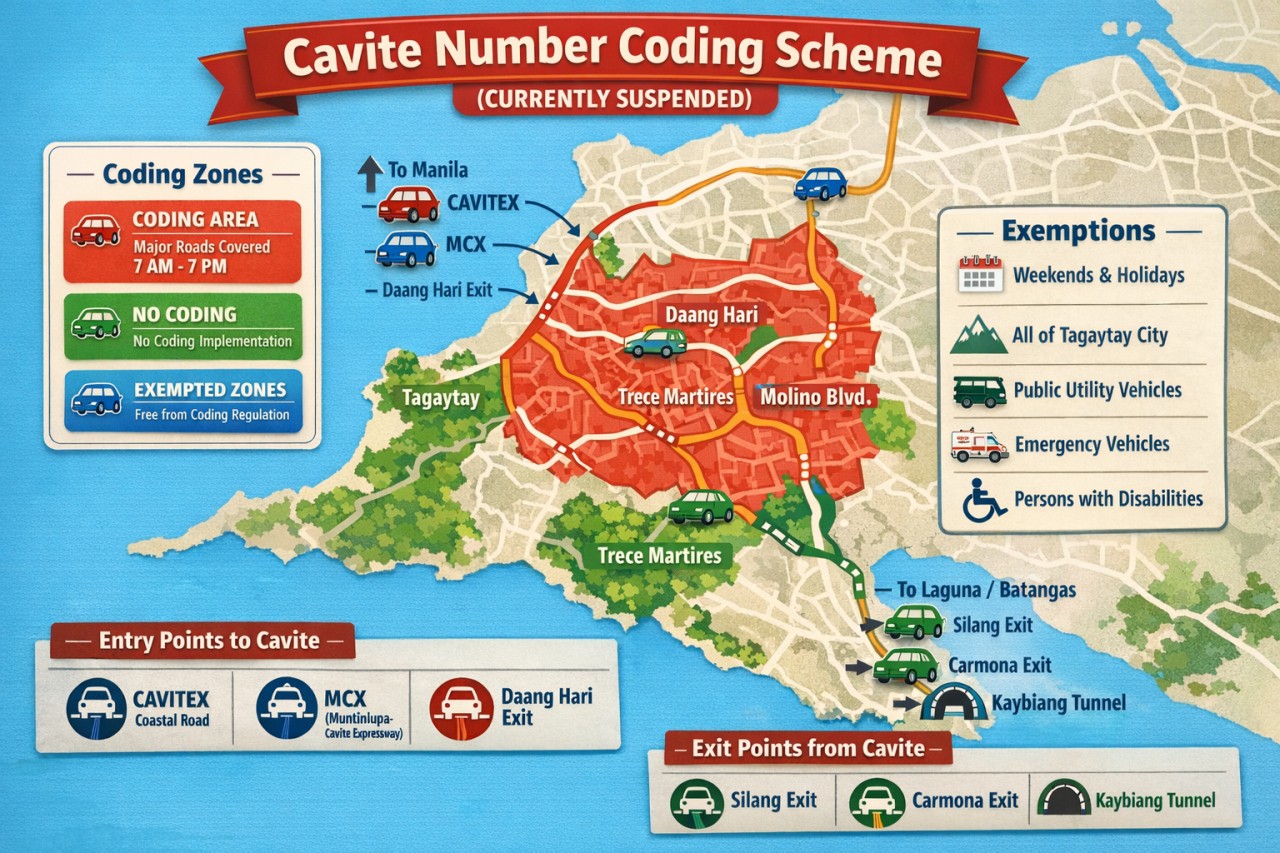
When active, Cavite coding restrictions focus on several major highways identified as congestion points, including:
- Aguinaldo Highway, from Bacoor to the Dasmariñas–Silang boundary
- Molino-Salawag-Paliparan Road, from Zapote in Bacoor to Paliparan in Dasmariñas
- Molino Boulevard, from Aguinaldo Highway to Molino-Salawag-Paliparan Road
- Governor’s Drive, from Carmona to Trece Martires City
These roads were selected because they serve as major commuter corridors connecting Cavite to nearby provinces and to Metro Manila.
Vehicle Types Covered
The Cavite coding scheme primarily targets private motor vehicles, including:
- Private cars
- SUVs
- Vans
- Pickup trucks
These vehicles are restricted from traveling on covered highways during coding hours based on their plate numbers
Exemptions
The ordinance also included several exemptions.
Roads and Areas
Because the ordinance only covers specific highways, the following roads are not included in the Cavite coding scheme:
- City roads
- Municipal roads
- Barangay roads
- Interior subdivision roads
- Provincial roads not listed in the official coverage
Only the four highways listed earlier are officially subject to coding restrictions.
Vehicle Exemptions
Some vehicles are allowed to travel despite coding restrictions. These include:
- public utility vehicles such as buses and jeepneys,
- emergency vehicles like ambulances and fire trucks,
- police and military vehicles with official markings, and
- trucks registered with the Philippine Economic Zone Authority (PEZA).
Additional exemptions could be granted to vehicles involved in:
- emergency situations
- medical services
- delivery of relief goods
- school transportation, and
- vehicles transporting perishable goods.
Individuals and organizations eligible for exemptions were required to apply for an official exemption sticker issued by the Road Safety Division of the Provincial Governor’s Office. The exemption was valid for one year and applied only to a specific registered vehicle.
Penalties
Motorists caught violating the Cavite coding rule (if active) could face:
- a PHP300 fine
- Confiscation of their driver’s license
- Issuance of a traffic citation ticket.
Note: Drivers were allowed to contest violations before a provincial review committee.
However, because the program is currently suspended, no coding penalties are being issued today.
Current Status of Cavite Coding Scheme
According to official notices from the Cavite Provincial Government, the number coding scheme remains suspended until further notice under Provincial Ordinance No. 283-2020.
The provincial government also clarified that:
- There are no deputized traffic enforcers authorized to enforce coding
- Drivers should not be apprehended for coding violations anywhere in Cavite.
This means motorists can travel across the province without worrying about plate-number restrictions and violations associated with it.
Cavite Number Coding Map
For a visual guide, please check out this coding map: