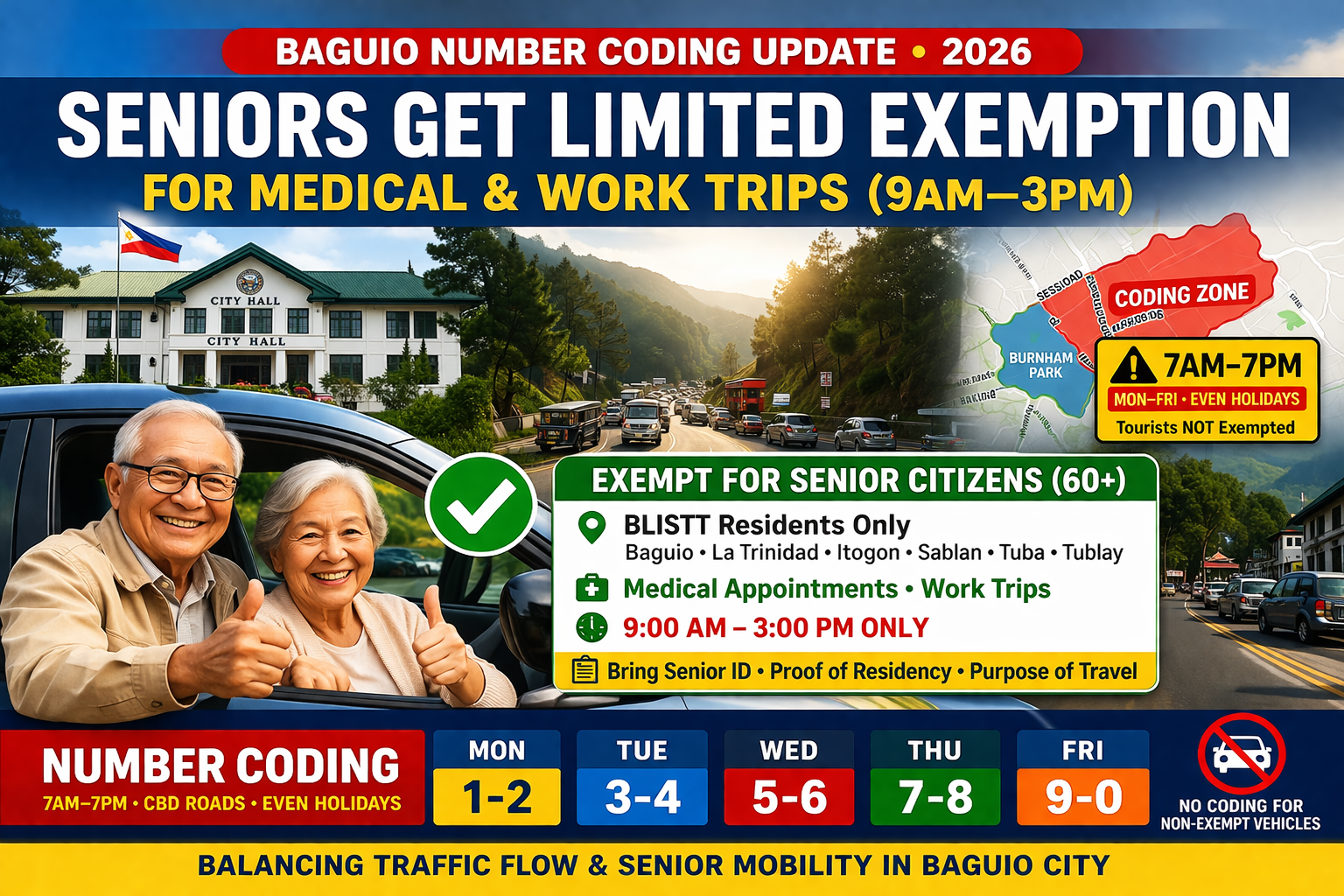
March 3, 2026 — Baguio City has updated its number coding rules to allow senior citizens (60+) from the BLISTT area to travel even on their coding day—but only for medical and work-related trips between 9:00 AM and 3:00 PM. This means seniors can now access hospitals, clinics, and workplaces without being penalized, as long as they carry proper documents.
However, the regular Baguio number coding still strictly applies from 7:00 AM to 7:00 PM, even on holidays, across major CBD roads. Outside the senior exemption window and purpose, all motorists—including tourists—must follow the coding schedule or risk penalties.
What Changed?
The latest update comes from Ordinance No. 94-2025, approved in December 2025, which amended the long-standing number coding law in Baguio. The change directly addresses a long-standing issue: mobility challenges for elderly residents, especially those needing medical care or still actively working.
Under the new rule, vehicles transporting seniors—whether the senior is the driver or passenger—are now part of official exemptions, but only under specific conditions:
- Must be a senior citizen (60+)
- Must be a resident of BLISTT (Baguio, La Trinidad, Itogon, Sablan, Tuba, Tublay)
- Travel must be for medical or work purposes
- Allowed only between 9:00 AM and 3:00 PM
This is not a blanket exemption. It’s targeted—and intentionally limited.
Why It’s Not That Simple
On paper, this looks like a compassionate move—and it is. But the city didn’t arrive here overnight.
Earlier attempts to fully exempt seniors faced pushback due to traffic concerns, enforcement confusion, and fairness issues. In fact, past proposals were even vetoed because:
- It could be abused without clear proof requirements
- It might worsen already heavy CBD traffic congestion
- Non-resident seniors (who also rely on Baguio hospitals) were left out
So what Baguio did instead was a controlled§compromise—a time-bound, purpose-specific exemption.
It solves one problem but creates a new responsibility: motorists must understand the limits clearly.
Full Baguio Number Coding Schedule
Even with the new exemptions, the standard number coding system remains unchanged:
- Monday: 1–2
- Tuesday: 3–4
- Wednesday: 5–6
- Thursday: 7–8
- Friday: 9–0
Notes:
- Coding applies from 7:00 AM to 7:00 PM
- It covers major roads in the CBD
- It applies even on holidays
- Tourists are NOT exempted
So, if you’re not covered by the exemptions, you’re expected to follow this.
Other Exemptions
Aside from senior-related medical exemptions, other vehicles still exempted from the regular coding rules include:
- Emergency vehicles
- Government vehicles on official duty
- School service vehicles (within set hours)
- Utility and repair service vehicles
- Vehicles involved in official events (with proper documentation)
But here’s the catch: each exemption requires proof. No documents, no exemption.
How to Avoid Coding Violations in Baguio
If you’re driving in Baguio, here’s how to avoid the stress from coding violations:
- Check your plate number before entering the CBD. Don’t rely on memory—double-check.
- If transporting a senior, prepare documents.
Bring:- Senior Citizen ID
- Proof of residency (BLISTT)
- Medical appointment or work ID
- Plan around the 9 AM–3 PM window. Outside that, coding rules apply again.
- Avoid assuming exemptions. When in doubt, follow the coding—it’s safer than getting fined.
Baguio’s move shows something important: number coding policies are evolving. It’s no longer just about reducing cars—it’s about balancing traffic flow with real human needs. But don’t mistake flexibility for leniency. If you want to avoid penalties and frustration: Make sure you understand the rules, respect the limits, and plan ahead.