The Land Transportation Office (LTO) is a government agency responsible for regulating drivers and land transportation. By this, we refer to the overseeing the process of registering motor vehicles, issuing driver’s licenses and permits, enforcing transportation laws, and handling cases related to traffic violations in the Philippines. It operates under the Department of Transportation (DOTr) and manages systems that help keep roads organized across the country.
For drivers, the LTO is the agency behind vehicle registration data and traffic enforcement frameworks you follow every day. It also works alongside other agencies that manage traffic and number coding policies, which are used to reduce congestion and control vehicle flow in busy areas like Metro Manila.
Understanding LTO
If you own a car or ride a motorcycle in the Philippines, you will eventually deal with the LTO. After all, it essentially keeps track of who drives, what vehicles are on the road, and whether they follow traffic rules. So, regardless if it is your first student permit application, or if you are renewing your driver’s license, or your vehicle registration you will have to interact with the LTO at some point. As the agency responsible for regulating drivers and vehicles nationwide, its work affects millions of motorists daily, from private vehicle owners to motorcycle riders, delivery drivers, and public transport operators.
The LTO operates under the Department of Transportation, and its mandate comes from Executive Orders No. 125, 125-A, and 226. These orders assign the LTO several key responsibilities such as:
- Registering motor vehicles
- Issuing driver’s and conductor’s licenses
- Enforcing transportation laws and regulations
- Handling traffic violation cases
History
The LTO did not appear overnight. The agency evolved alongside the growth of transportation in the country. When the number of motor vehicles began increasing on roads in Manila and nearby areas in the early 1900s, the government introduced rules to regulate them. In 1912, Legislative Act No. 2159 was passed. This law created an Automobile Section under the Bureau of Public Works to regulate motor vehicles and drivers. Over time, transportation laws became more organized and agencies continued to evolve.
Through the years, several changes shaped the transportation system:
- The Division of Motor Vehicles replaced earlier offices in the 1930s
- In 1947, the Motor Vehicles Office (MVO) was created
- In 1964, RA 4136, also known as the Land Transportation and Traffic Code, established the Land Transportation Commission
Later, government reforms reorganized transportation agencies again. By 1987, the Land Transportation Office (LTO) and the Land Transportation Franchising and Regulatory Board (LTFRB) were created. The LTO took responsibility for licensing, vehicle registration, and traffic law enforcement, while the LTFRB focused on regulating public transport franchises. To date, the LTO still operates offices across the country, including regional offices that serve different parts of the country.
What the LTO Actually Does
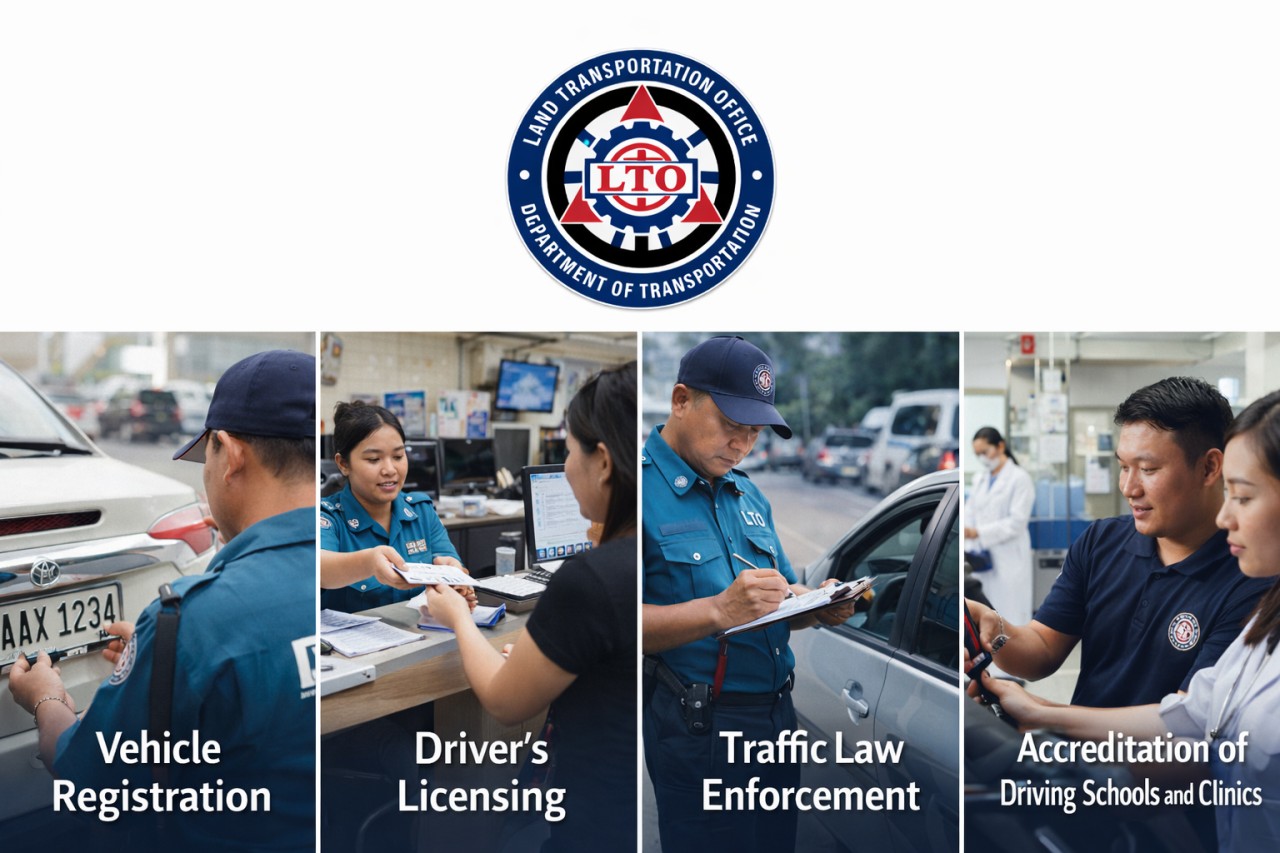
Many people associate the LTO with driver’s licenses. But the agency performs several major functions that keep the land transportation system organized.
1. Vehicle Registration
All motor vehicles in the Philippines must be registered with the LTO.
Registration includes:
- Recording vehicle ownership information
- Issuing license plates
- Updating vehicle records
- Conducting inspections when required
Vehicle registration allows authorities to identify cars on the road and monitor compliance with transportation laws.
2. Driver’s Licensing
The LTO regulates and issues driver’s licenses.
Common license transactions include:
- Student-Driver’s Permit
- New Non-Professional Driver’s License
- Professional Driver’s License
- License renewal
- Additional license codes
Applicants must pass written and practical driving exams to demonstrate their ability to operate vehicles safely.
The agency also introduced five-year and ten-year driver’s license validity, which reduces how often drivers need to renew their licenses.
3. Traffic Law Enforcement
The LTO helps enforce transportation laws throughout the country.
The agency works with other authorities such as:
- Traffic enforcement units
- Local government offices
- National law enforcement groups
These partnerships help regulate road behavior and manage violations such as reckless driving, drunk driving, and distracted driving.
Traffic enforcement systems also support broader traffic management programs, including policies like number coding that regulate vehicle use during busy hours.
4. Accreditation of Transportation Entities
The LTO also regulates organizations connected to the transportation industry.
This includes accrediting:
- Driving schools
- Medical clinics for driver exams
- Vehicle manufacturers and dealers
Accreditation helps maintain consistent standards for training, testing, and vehicle documentation.
Major Laws Enforced by the LTO
The LTO also operates under several national laws designed to promote road safety and organized traffic.
Some of these laws include:
- RA 4136 – Land Transportation and Traffic Code
- RA 10930 – Driver’s license reforms and longer validity
- RA 10586 – Anti-Drunk and Drugged Driving Act
- RA 10913 – Anti-Distracted Driving Act
- RA 10054 – Motorcycle Helmet Act
- RA 8750 – Seat Belt Use Act
- RA 10666 – Children’s Safety on Motorcycles Act
These laws guide driver behavior and define penalties for violations.
LTO, Traffic, and Number Coding
Traffic congestion is a daily challenge in many cities across the Philippines, especially in urban areas like Metro Manila. To manage heavy traffic, authorities implement traffic management policies such as the number coding scheme which restricts vehicles from using certain roads on specific days based on the last digit of their license plate.
While agencies like the MMDA manage coding rules in Metro Manila, the system relies heavily on vehicle registration data and traffic enforcement frameworks connected to the LTO.
Modern Services and Digital Systems
The LTO has also introduced digital tools to improve public services. One of the most notable systems is the Land Transportation Management System (LTMS). This platform allows drivers to:
- Access driver records
- Process transactions online
- Check violations
- Manage licensing information
Digital systems help reduce long lines at LTO offices and make services more accessible to drivers.
How to Contact the LTO
For inquiries or assistance, you may contact:
Land Transportation Office (LTO)
- Office Address: Central Office – East Avenue, Quezon City, Philippines
- Email: ltomailbox@lto.gov.ph, ltoco.feedback@gmail.com, c3@lto.gov.ph
- Central Command Center: 1-342-586
- You may also visit the official website for more information and services.
If you drive regularly in the Philippines, knowing how the LTO works can help you avoid penalties, stay compliant with traffic laws, and move around the country’s roads with fewer surprises.